


What Is the House Edge in Blackjack? Rules That Change the Odds

What Is the House Edge in Blackjack? Rules That Change the Odds

Two blackjack tables can use the same cards, the same green felt, and the same basic objective while offering noticeably different mathematics. The reason is hidden in the rules.

Asking What Is the House Edge in Blackjack? therefore requires more than quoting one percentage.

Blackjack’s casino advantage changes according to payouts, dealer procedures, deck count, doubling options, splitting rules, surrender, and how accurately the player follows basic strategy.

Some adjustments move the edge only slightly, while others make a surprisingly large difference. Understanding them makes comparing blackjack tables much easier.

Start With the Meaning of House Edge

House edge represents the casino’s expected long-term advantage relative to the player’s initial wager.

It is not a prediction for one session.

If a theoretical game has a 1% house edge, the casino would expect to retain around $1 for every $100 of initial wagering over a sufficiently large sample.

That does not mean a player betting $100 will necessarily finish with $99.

Short-term outcomes can vary enormously because cards are random and blackjack includes doubles, splits, natural blackjacks, and pushes.

The UK Gambling Commission describes house edge as a measure of what the casino expects to retain on average under normal play.

The word average is doing a lot of work there.

The Best Blackjack Rules Can Keep the Edge Relatively Small

Blackjack has a reputation for offering relatively competitive casino odds because correct player decisions can reduce the operator’s advantage.

But there is no universal percentage.

Wizard of Odds’ house edge calculator includes thousands of combinations created by changing factors such as number of decks, soft-17 procedure, surrender, splitting, doubling, and blackjack payout.

One common European ruleset – six decks, dealer standing on soft 17, doubling on 9–11, double after split, and no dealer peek – has a calculated house edge of about 0.62% when the correct strategy is followed.

Change those rules, and the edge changes.

That is why “blackjack has a 0.5% edge” should be treated as a rough example, not a universal fact.

3:2 vs 6:5 Is a Major Difference

If you check only one rule, make it the blackjack payout.

At a 3:2 table, a $20 natural blackjack produces $30 profit.

At 6:5, the same hand earns only $24.

You are giving up $6 on that particular result.

Wizard of Odds calculates that replacing 3:2 with 6:5 reduces player return by roughly 1.39 percentage points under its standard baseline rules.

That is a large shift in blackjack terms.

A table can advertise single-deck play, polished live dealers, or exciting side bets, but a 6:5 natural-blackjack payout can materially worsen the main game’s mathematics.

This is why experienced players often look for “Blackjack Pays 3:2” before checking smaller details.

Dealer Hits Soft 17 Adds to the Edge

Soft 17 means a dealer hand such as Ace-6, where the Ace counts as 11.

If the dealer stands on soft 17, the rule is called S17.

If the dealer must hit, it is H17.

H17 is less favourable to the player.

Wizard of Odds estimates a roughly 0.22-percentage-point reduction in player return when the dealer hits soft 17 rather than stands, assuming the other comparison rules remain constant.

That might not sound dramatic.

But blackjack edges can already be below 1%, so a change of two-tenths of a percentage point is meaningful.

It is also a perfect example of why tiny wording in the rules panel can matter more than the visual presentation of the table.

Double After Split Is More Valuable Than It Looks

Suppose you split a pair and receive a strong two-card hand such as 11 on one of the new hands.

If double after split, or DAS, is permitted, you can increase the wager when the mathematical situation is favourable.

Without DAS, that option disappears.

Wizard of Odds estimates that prohibiting double after split costs the player approximately 0.14 percentage points relative to allowing it under the comparison baseline.

Doubling restrictions elsewhere have an effect too.

Limiting doubles to hard totals of 9–11 instead of allowing them on any first two cards costs roughly another 0.09 percentage points.

Neither rule creates a dramatic difference alone.

Stack several restrictive rules together, however, and the final house advantage can become noticably larger.

European No-Hole-Card Rules Can Increase Risk

American-style games commonly allow the dealer to check for blackjack when showing an Ace or ten-value card before players make additional bets.

Traditional European No Hole Card, or ENHC, games may allow players to split or double before discovering that the dealer has blackjack.

In full-loss versions, the extra wagers can be lost too.

Wizard of Odds estimates that traditional ENHC rules reduce player return by around 0.11 percentage points relative to a comparable peek structure.

Some no-hole-card games use Original Bets Only rules that protect extra split or double wagers when the dealer eventually has blackjack.

That can materially change the effect.

This is another reason the title of the game is not enough.

Read how the dealer actually handles blackjack.

Fewer Decks Usually Help – All Else Equal

Many players instinctively look for single-deck blackjack.

There is mathematical logic behind that preference.

Wizard of Odds estimates that moving from its eight-deck baseline to single-deck play improves player return by about 0.48 percentage points, assuming the rest of the rules remain identical.

But casinos do not always keep everything else identical.

A single-deck game may compensate with a 6:5 payout, H17, or less flexible doubling.

Those disadvantages can outweigh the benefit of fewer decks.

So “single deck” should never be treated as shorthand for “lower house edge.”

The complete ruleset still decides the outcome.

Surrender Can Slightly Improve Player Return

Late surrender allows a player to give up certain weak starting hands and lose only half of the original wager.

That may sound like admitting defeat, but mathematically it can be valuable.

Wizard of Odds lists late surrender as improving player return by around 0.08 percentage points under its standard comparison.

The practical value is that some hands have such poor prospects against strong dealer up-cards that losing half a bet is preferable to playing the whole hand.

Not every table offers surrender.

When comparing two otherwise similar games, its availability is another small rule worth checking.

Blackjack’s edge is often created by the accumulation of many details like this.

Basic Strategy Is Part of the House-Edge Calculation

Rule quality matters, but player decisions matter too.

House-edge figures for blackjack are generally calculated assuming optimal or near-optimal strategy.

If a player repeatedly makes poor decisions, their personal expected loss can be higher than the published mathematical edge.

For example, taking insurance without a specific mathematical reason, standing on weak totals in the wrong situations, or refusing favourable doubles can increase expected losses.

Basic strategy does not involve guessing which card will appear next.

It simply compares the expected values of hit, stand, double, split, and surrender based on the known cards and rules.

The correct chart also changes between rulesets, which is why using one generic strategy for every blackjack table can be matematically inaccurate.

Side Bets Should Be Evaluated Separately

A table can have an excellent main-game house edge while offering optional wagers with much larger casino advantages.

Insurance is a familiar example.

Wizard of Odds calculates a house edge of about 5.9% on insurance in a single-deck game based on the normal card composition.

Other side wagers such as Perfect Pairs or poker-style combinations use entirely different probability and payout structures.

Do not average them mentally into the main game.

If you wager $10 on blackjack and another $5 on a side bet, you are effectively participating in two mathematical propositions at the same time.

Each should be evaluated on its own rules.

How to Compare Blackjack Tables Quickly

You do not need to calculate thousands of combinations manually.

Start by checking the natural blackjack payout. Prefer 3:2 over 6:5 when other conditions are comparable.

Then check whether the dealer stands or hits soft 17, whether double after split is allowed, the deck count, surrender availability, and any special hole-card rules.

Regulated online games should make relevant rules and information about house edge, RTP, or probabilities accessible before customers commit to gamble.

That makes the help screen one of the most useful parts of a blackjack game.

Ignore it, and two visually identical tables can hide very differnt mathematics.

So, What Is the House Edge in Blackjack? It is not one fixed percentage but the combined result of rules and player strategy. A 3:2 payout, S17, flexible doubling, DAS, surrender, and favourable deck conditions can all improve expected return.

Before choosing a table, compare its rules rather than its graphics or minimum bet. Small percentage changes may look minor, but over long-term play they genuinely matter.


What Makes a Professional Live Casino Dealer? Inside the Studio

What Makes a Professional Live Casino Dealer? Inside the Studio

When a live roulette wheel starts spinning, most players focus on the ball. During blackjack, attention usually stays on the cards. The person running the table can almost disappear into the background when everything works correctly.

That is actually a sign of skilled dealing. To understand What Makes a Professional Live Casino Dealer?, it helps to look behind the broadcast.

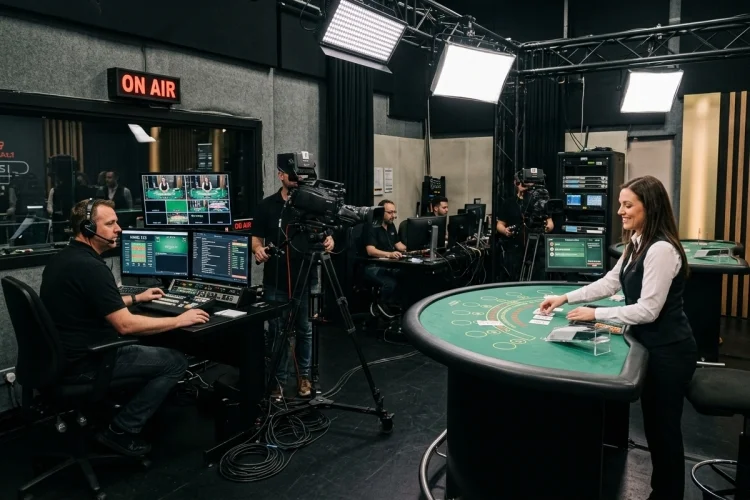
Today’s dealer works inside a carefully managed studio containing cameras, game-control systems, supervisors, and strict procedures.

The role blends casino knowledge with television-style presentation, customer service, and the ability to stay precise while working live.

A Live Dealer Is Also a Broadcast Presenter

A modern live casino dealer has two audiences: the gaming system and the people watching through their screens.

That changes the role considerably compared with the traditional image of a casino croupier.

Evolution describes its presenters as leading games live from a studio by opening rounds, accepting betting periods, dealing cards or spinning wheels, announcing winners, and interacting with players.

Current job descriptions go even further, comparing the position to a combination of dealer, live host, and customer-service professional.

The dealer therefore needs enough personality to make the broadcast engaging while remaining focused on procedures.

It is entertainment, but structured entertainment.

Training Turns Simple Movements Into Procedures

Dealing a card looks easy until every movement has to be completed exactly the same way under a camera.

Professional dealers train their physical movements, verbal announcements, game rules, and response procedures before appearing live.

Evolution currently states that new US casino dealers receive hands-on training covering games such as blackjack, roulette, baccarat, and on-camera presentation.

Formal training is also part of regulatory expectations in some jurisdictions.

The UK Gambling Commission’s live studio standards state that croupiers need adequate training to provide gambling fairly according to documented procedures and game rules. Refresher training should also be documented.

This is why an experienced dealer’s movements can look almost effortless.

What appears casual has usually been practised repeatedly.

Dealers Need to Understand the Rhythm of Each Game

Every table game has its own rhythm.

Roulette contains a betting period, wheel spin, betting closure, result, and payout stage. Blackjack moves through initial cards, player decisions, dealer actions, and settlement. Baccarat follows another sequence.

Professional dealers learn to make these stages feel continuous.

If the presenter moves too slowly, the game becomes dull. If they rush, players can feel confused or procedures can become sloppy.

Evolution specifically looks for presenters who can keep gameplay smooth while following on-screen prompts and studio procedures accurately.

Pacing is therefore partly technical and partly social.

A strong dealer develops a natural tempo that gives players enough time to understand what is happening without filling every second with unnecessary conversation.

Good Presentation Is More Than Smiling at the Camera

Camera confidence is easy to underestimate.

A dealer may spend much of a shift under studio lighting while being broadcast continuously to players they cannot physically see.

They need clear speech, comfortable posture, controlled hand movements, and a professional expression even during repetitive rounds.

Evolution’s recruitment material highlights confidence, personality, professional presentation, and the ability to entertain as important parts of the game presenter role.

The challenge is avoiding both extremes.

A dealer who looks uninterested can make a game feel lifeless. A presenter who performs too aggressively can distract from the game itself.

Professional presence sits in the middle: relaxed, attentive, friendly, and beleivable.

Fairness Depends on More Than the Dealer

The dealer is highly visible, but live casino integrity is built around an entire operating system.

The UK Gambling Commission requires applicable live dealer operations to be fair and independently auditable. Its guidance covers commercial-quality equipment, trained croupiers, supervision, surveillance, controlled access, and game records.

That means dealers work inside a monitored environment.

Their activities may be recorded so that procedures can be reviewed if a dispute or irregularity occurs. Supervisors can also oversee dealer behaviour and equipment integrity.

This should change how players think about professionalism.

A trustworthy live table does not depend entirely on whether the dealer appears friendly. It depends on the combination of trained staff, documented procedures, supervision, equipment controls, and regulatory requirements.

The presenter is one part of that chain.

Handling Mistakes Professionally Is a Critical Skill

Live games involve physical objects and human actions, which means unusual situations can happen.

A card might be mishandled, a dealer may need clarification, or a piece of equipment could require attention.

Professionalism becomes especially visible at that moment.

An inexperienced person may panic or try to hide the mistake. A trained dealer follows procedure.

Because live operations are supervised and recorded, the goal is not to pretend errors never happen. The goal is to resolve irregularities transparently and according to established rules.

This also requires emotional control.

The dealer may know that hundreds or thousands of people are watching. Staying calm while waiting for a supervisor or correcting a procedure is an important part of the role.

A smooth game matters, but integrity matters more.

Player Interaction Should Feel Natural, Not Pushy

One advantage of live casino over automated games is the presence of a real person.

Players can often communicate through chat, and the dealer may greet them, respond to comments, or briefly explain what is happening.

Evolution describes game presenters as creating a welcoming experience by chatting with players while explaining rules and maintaining gameplay.

However, good interaction has boundaries.

A professional dealer should not make a player feel pressured to increase stakes or continue gambling.

In Great Britain, responsible product standards specifically prohibit gambling products from actively encouraging customers to chase losses, increase stakes, or continue after they have indicated a wish to stop.

That broader principle fits professional presentation well.

Good service means making the game clear and welcoming—not trying to manipulate someone’s betting behaviour.

Concentration Becomes Harder Because the Job Is Repetitive

A dealer may perform the same basic action hundreds of times.

That repetition creates one of the less obvious challenges of the job: staying mentally engaged.

The 200th blackjack hand needs the same procedural care as the first. The same is true for announcing roulette results or managing betting windows late in a shift.

Evolution specifically describes attention to detail and professionalism as core requirements for studio presenters.

This is where consistent performers stand out.

A momentary lapse in concentration can cause an incorrect announcement, procedural mistake, or unnecessary delay.

Maintaining focus is therefore not just a personal work habit. It contributes directly to game quality.

Technology Works With the Dealer, Not Instead of Them

Live casino studios combine physical dealing with digital infrastructure.

Professional cameras stream the table. Software manages betting interfaces. On-screen prompts can guide parts of the workflow, while players participate remotely from different devices.

Evolution describes its live casino products as combining purpose-built studios, professional hosts, advanced streaming technology, and continuously operating digital games.

Pragmatic Play similarly describes its live casino setup as using trained professional dealers alongside dedicated studios, advanced broadcasting systems, 4K cameras, and multilingual interfaces.

Technology does not make the presenter less important.

Instead, it changes which skills matter.

The dealer needs to coordinate physical actions with digital timing while remaining natural on camera. That mixture of casino technique and broadcasting is what makes live casino dealing a specialised profession rather than simply a traditional dealer job moved online.

A Professional Dealer Makes the Process Feel Invisible

One of the strongest signs of quality is that players barely notice the complexity behind a round.

The betting period opens. The dealer performs the required action. Results are clear. The next round begins without confusion.

That smoothness depends on dozens of small skills working together.

Game knowledge prevents procedural errors. Presentation skills maintain engagement. Concentration protects accuracy. Communication keeps players informed. Studio procedures provide accountability.

When all of those elements are present, the dealer does not need to dominate the experience.

They simply make the game easy to follow.

That may be the clearest definition of professional live dealing.

Understanding What Makes a Professional Live Casino Dealer? means looking beyond a friendly voice or polished appearance.

The strongest dealers combine training, procedural accuracy, camera presence, communication, concentration, and respect for game integrity.

When watching a live game, notice how smoothly the presenter manages both people and procedure. The best dealers make a technically complex broadcast feel simple, natural, and consistant from round to round.

Why Slot Results Cannot Be Predicted from Previous Spins and Streaks

Why Slot Results Cannot Be Predicted from Previous Spins and Streaks

Watch a slot long enough and patterns seem to appear everywhere. Three wins arrive close together, a bonus disappears for dozens of rounds, or the same high-value symbol repeatedly lands just outside the payline.

These sequences can make a game feel readable. In reality, understanding Why Slot Results Cannot Be Predicted from Previous Spins means separating patterns we can see from probabilities that actually affect the next round.

In standard RNG-based play, past results do not tell the game what to produce next, so a streak is history rather than a reliable forecasting signal.

Random Does Not Mean Perfectly Mixed

One reason slot patterns seem suspicious is that people often have the wrong picture of randomness.

We imagine random results should look evenly distributed. A win should appear, then some losses, another win, perhaps a bonus, and so on.

Real randomness can look much messier.

Imagine flipping a coin 100 times. A perfectly alternating sequence of heads, tails, heads, tails would actually look suspicious. A real random sequence is likely to include clusters such as four heads followed by several tails.

Slot outcomes can create similar patterns.

Several prizes may appear within a short period. Long stretches may contain nothing significant. Those clusters do not necessarily reveal hidden cycles; they are normal occurences within probabilistic systems.

Why a “Cold” Slot Is Not Automatically Due to Pay

Suppose someone watches a slot produce 40 spins without a major prize.

The instinctive reaction may be, “Surely it has to pay soon.”

But consider a fictional event with a 2% probability on each independent round. That means each new qualifying spin has a 2% chance under our simplified example.

Forty previous misses do not convert the next spin into a guaranteed win.

This is where intuition clashes with probability. People often expect randomness to correct itself quickly.

Over enormous samples, observed frequencies may move closer to theoretical probabilities. But that does not mean the process has to balance itself within a player’s next five, ten, or 100 spins.

A cold-looking session can continue to look cold.

A “Hot” Slot Is Not Predictive Either

The opposite belief is equally misleading.

Suppose a slot has just awarded several prizes. Some players may assume it has entered a hot period and keep playing because they expect the trend to continue.

Others believe the exact opposite – that the slot has “used up” its wins and must now become cold.

Both ideas attempt to use previous results as information about a future random outcome.

Neither works when game rounds are independent.

The next result comes from the game’s mathematical probability model, not from a requirement to continue or reverse the recent trend.

A winning streak can be exciting, but statistically it is a description of past events rather than a reliable map of future ones.

Why the RNG Does Not Remember Your Session

Online slots commonly use a Random Number Generator to produce unpredictable values used in determining game outcomes.

The RNG does not need to remember that you personally lost ten previous rounds and compensate you on the eleventh.

Technical standards in regulated markets specifically address this issue. The UK Gambling Commission requires random outcomes to be unpredictable and says games must not use adaptive behaviour that changes probabilities based on previous payouts or the amount won or lost.

This matters because myths often describe online slots as if they have a hidden emotional memory.

“The machine took enough money.”

“It has already paid too much.”

“It knows I increased my stake.”

These explanations may feel intuitive after a dramatic session, but they are not how compliant independent RNG outcomes are intended to work.

Near-Misses Are Visually Powerful but Statistically Misleading

Imagine needing three special symbols to trigger a feature.

Two appear, while the third lands just above the visible winning position.

That feels incredibly close.

Compare it with a spin containing none of the required symbols. Emotionally, the two-symbol result seems much more important.

But unless the game’s documented mechanics say otherwise, a near-miss does not store progress toward the next feature.

The next spin is not rewarded for nearly winning previously.

This distinction matters because visual presentation can create a sense of momentum that does not exist mathematically.

A symbol landing one position away might look more promissing, yet it cannot tell you which random outcome will be generated next.

Spin Histories Describe the Past, Not the Future

Casino interfaces sometimes display previous results.

That information can be interesting, but it should not automatically be treated as predictive data.

Imagine a visible history showing:

Loss, loss, loss, small win, loss, loss, bonus.

What pattern comes next?

There is no reliable answer based only on that sequence.

You could invent many stories around it. Perhaps bonuses appear every seven rounds. Maybe the slot becomes generous after five losses. Perhaps another bonus will come quickly because the game is hot.

The problem is that these stories are created after seeing the data.

Random sequences allow humans to find apparent patterns almost anywhere. The difficult part is proving that those patterns have genuine predictive power on future independent rounds.

In regulated random slots, historical outcomes by themselves do not provide that advantage.

RTP Cannot Be Used as a Personal Payback Meter

RTP creates another popular prediction mistake.

A player might know that a game has a theoretical 96% RTP, spend $200 while receiving only $100 back, and conclude that the slot must soon return more money to reach 96%.

It does not work that way.

Theoretical RTP is calculated over a huge number of game rounds, not one person’s session.

The UK Gambling Commission explains that actual return can vary significantly over shorter periods. Volatility further influences how widely results may move around the theoretical expectation.

A high-volatility game can be particularly dramatic because more of its theoretical payout may be concentrated in less frequent prizes.

Your personal balance is therefore not a gauge showing how far the slot is behind its RTP obligation.

There is no individual “refund point” waiting ahead.

Volatility Explains Swings Without Predicting Them

Volatility is useful for understanding why some slots produce more dramatic sequences than others.

Low-volatility games generally concentrate more payout value in smaller, more frequent prizes. High-volatility games can place greater weight on larger but less frequent outcomes.

This can explain the character of a game without revealing the next result.

For example, knowing that a slot is highly volatile can tell you that long prize-free stretches may be more consistent with its mathematical design.

It does not mean that a big prize becomes increasingly likely as the losing streak grows.

Volatility describes the distribution of outcomes. It is not a timer.

Confusing these two concepts can lead players to continue far longer than intended because they believe the “big one” must be approaching.

Can Anyone Find a Pattern That Beats an RNG?

If previous results do not predict future independent spins, recording hundreds of outcomes does not create a secret forecasting system.

A spreadsheet can show frequencies, streak lengths, average returns, or how often certain visible events occurred in your sample.

That may be interesting statistically, but descriptive data and predictive data are not the same thing.

A small sample can also be especially decieving. A rare symbol appearing five times in 500 rounds does not establish a dependable cycle.

Independent testing laboratories evaluate gambling systems using much larger samples and technical methods rather than trying to identify simplistic streak patterns.

Regulated game testing can include examination of RNG implementation, theoretical game mathematics, and whether outcomes conform to required standards.

The Important Exception: Published Stateful Features

Not every modern slot resets every visible feature after each round.

Some games include collection meters, persistent symbols, guaranteed features, or progress mechanics that explicitly carry between spins.

Suppose the game rules say that collecting ten tokens activates a bonus and your meter shows nine. Obviously, the existing meter matters.

That does not contradict random outcome principles.

You are responding to a documented game state rather than claiming that five previous losses make the RNG more likely to produce a win.

Players should always check the rules because stateful mechanics can affect available outcomes or features.

The key distinction is simple: published game mechanics can contain memory; independent random results do not become predictible merely because a streak occurred.

The Practical Lesson: Do Not Chase a Pattern

Believing that previous spins predict the future can influence betting behaviour.

A player who thinks a bonus is overdue may raise the stake. Someone who believes a machine is hot may extend a session beyond the original budget.

Neither decision changes the underlying randomness.

If you decide to play, a more practical approach is to set an entertainment budget before starting and choose a stake that fits it.

When the predetermined limit is reached, a streak should not become a reason to keep chasing.

Randomness means the next spin could win or lose, not that the game owes either outcome.

The reason Why Slot Results Cannot Be Predicted from Previous Spins is straightforward: independent RNG outcomes do not become more predictable because of streaks, near-misses, or past losses.

RTP and volatility can describe a game’s mathematics, but neither forecasts the next round.

Use game statistics to understand risk, not to hunt imaginary patterns. Set clear limits and treat every new independent spin as uncertain.

How to Read Online Casino Terms and Conditions and Spot Red Flags

How to Read Online Casino Terms and Conditions and Spot Red Flags

Most players do not read every line of a casino agreement before registering. That is understandable. Terms and conditions can stretch across thousands of words and mix practical information with dense contractual language.

The smarter approach is not necessarily reading every sentence with equal attention. Learning how to read online casino terms and conditions means identifying the clauses capable of changing what happens to your deposits, winnings, bonuses, and account.

Once you know where those clauses usually hide, reviewing a casino becomes quicker – and spotting questionable conditions becomes much easier.

Scan the Significant Conditions First

Start by searching the page for words that directly affect money.

Useful terms include “withdrawal,” “bonus,” “wagering,” “maximum bet,” “verification,” “restricted,” “account closure,” “fees,” “inactive,” and “complaint.”

This technique helps you identify financially important clauses before reading less relevant sections.

The UK Gambling Commission defines significant promotional conditions as restrictions such as eligibility rules, time limits, qualification requirements, maximum stakes, and wagering requirements.

A reputable operator should not force players to hunt through several unrelated pages to discover essential restrictions. Important conditions should be reasonably clear before the player commits to an offer.

Be Cautious With “Sole Discretion”

One phrase worth noticing is sole discretion.

It normally means that one party has the authority to decide how something should be handled. That does not automatically make a clause unfair, but extremely broad discretion can create uncertainty.

For example, compare a term saying an account may be suspended when there is reasonable evidence of fraud with a vague clause allowing winnings to be removed whenever the operator “considers activity inappropriate.”

The second version gives the customer much less clarity.

The Gambling Commission has previously raised concerns about potentially unfair terms that give licensees excessive discretion, including clauses concerning confiscation of deposits or winnings.

Clear rules should tell you what action triggers a consequence rather than leaving everything open-ended.

Examine Every Promotional Restriction

Bonus terms deserve their own reading session.

A promtional offer may contain wagering requirements, maximum bet limits, expiry dates, game restrictions, minimum deposits, maximum convertible winnings, or different contribution percentages.

Suppose you receive a $100 bonus requiring $1,000 of qualifying wagering. If slots contribute 100% but another category contributes only 20%, wagering $100 on that second category may reduce the requirement by only $20 under that hypothetical structure.

This is why headline percentages tell only part of the story.

Great Britain’s rules provide a useful example of how regulation can affect bonus structures. Since January 19, 2026, relevant bonus wagering requirements for licensed operators cannot exceed 10x the bonus funds.

That rule does not automatically apply elsewhere, so always check the jurisdiction governing your particular account.

Check Maximum Bets and Bonus Expiry Dates

Maximum bet clauses are easy to overlook because they may appear deep inside bonus conditions rather than on the promotional banner.

A casino might specify that wagers above a particular amount do not qualify while restricted bonus funds are active. Breaking that rule could affect bonus eligibility depending on the contract and local consumer protection requirements.

Expiry periods matter for the same reason. If a bonus must be completed within seven days, claiming it when you only intend to play occasionally may offer little practical value.

Before accepting any bonus, write down three numbers: the wagering requirement, maximum qualifying stake, and expiry period.

This simple habit makes complicated offers far easier to compare.

Investigate Withdrawal Restrictions Carefully

Withdrawal clauses deserve more attention than almost any other section.

Look for minimum cash-out amounts, payment processing fees, documentation requirements, transaction limits, expected procedures, and circumstances in which payments can legitimately be delayed.

Also ask whether the terms distinguish deposited funds from restricted bonus money.

British guidance requires operators to allow withdrawal of the deposit balance even when a bonus is pending or active, except where restrictions are necessary for general regulatory obligations.

A vague clause saying withdrawals can be delayed indefinitely should therefore attract more scrutiny than a clearly described identity or anti-fraud review.

Remember that payment processing and operator approval are also different stages. A casino can release funds while a bank or payment provider still needs time to recieve them.

Review Account Closure and Inactivity Clauses

What happens if you stop using the account?

Search for terms such as “dormant account,” “inactive account,” “closure,” and “administration fee.” Some contracts explain how unused balances are handled after extended inactivity.

You should also investigate rules concerning duplicate accounts, incorrect registration information, chargebacks, collusion, or suspicious activity.

These clauses are legitimate areas for an operator to address, but they should explain the prohibited behaviour clearly.

A red flag appears when a minor technical breach seems to give the operator unlimited authority to remove unrelated real-money balances without a reasonable connection between the violation and the consequence.

Check How Contract Changes Are Handled

Another overlooked section explains whether the casino can change its rules after you register.

Terms naturally need updating as laws, products, and payment systems change. The question is whether material amendments are communicated fairly.

Great Britain licence conditions state that customer contract changes must meet fairness and transparency requirements and that players should be notified of material changes before they take effect.

Malta Gaming Authority rules similarly require material changes to be communicated and expressly accepted before players continue using the gaming service.

Look for a “last updated” date as well. Saving a copy of relevant terms can be useful when depositing a meaningful amount or accepting a complex promotion.

Read the Complaints and ADR Section

Good terms should explain what happens when the player and operator disagree.

Find the customer complaint procedure, response method, escalation path, and any independant Alternative Dispute Resolution service associated with the operator.

Under MGA player-protection requirements, operators must provide a complaints procedure and allow unresolved disputes to be referred to a registered ADR entity after the internal process has been exhausted.

eCOGRA similarly deals with certain contractual and transactional disputes, including account management, bonus applications, gambling transactions, and allegedly misleading terms.

If a dispute occurs, communicate in writing whenever possible. Screenshots, timestamps, transaction IDs, emails, and copies of the applicable terms can be far more useful than relying on memory.

Ask Whether the Terms Feel Clear and Predictable

One final test is surprisingly simple: can you predict what happens if you follow – or break – a particular rule?

Well-written terms should give reasonably clear answers. You should know what qualifies for a bonus, what prevents a withdrawal, when verification may happen, and how a complaint can be escalated.

Recent Gambling Commission research published in 2026 highlighted transparency and understandable terms as important elements of consumer trust in gambling.

If important financial rules remain confusing after careful reading, that uncertainty itself is worth considering before depositing money.

Learning how to read online casino terms and conditions is less about memorising legal language and more about recognising financial consequences.

Focus on bonus restrictions, withdrawal rules, account powers, fees, changes, and dispute procedures.

Before registering or claiming an offer, scan these sections carefully and save important conditions. A clear contract helps you understand exactly what you are agreeing to before real money becomes involved.

Common Baccarat Mistakes That Can Make the Game More Expensive

Common Baccarat Mistakes That Can Make the Game More Expensive

Baccarat does not ask you to make complicated card decisions, which can make it seem almost mistake-proof.

The cards are drawn according to fixed rules, and the main choice is usually whether to back Player, Banker, or Tie. Yet many Common Baccarat Mistakes have little to do with drawing cards.

They happen when players misunderstand paytables, choose expensive side bets without checking the odds, increase stakes during losing streaks, or assume previous outcomes reveal what comes next.

These errors can change how much money is exposed even though the underlying card rules remain exactly the same.

Mistake 1: Picking a Table Without Reading the Rules

Not every baccarat table uses the same payout structure.

Traditional baccarat commonly charges commission on winning Banker bets. Other games advertise No Commission play but reduce the payout on specific Banker outcomes.

Some variants add multipliers, unusual side wagers, or special card conditions.

That means choosing a baccarat table based only on graphics or minimum bet can be misleading.

Open the game information first and check how Player, Banker, Tie, and optional bets are settled.

A familiar table layout does not guarantee an identical paytable.

Mistake 2: Thinking “No Commission” Means No Trade-Off

Removing commission sounds automatically beneficial.

But casinos can adjust another part of the payout structure instead.

For example, a No Commission game may pay most Banker wins at 1:1 but reduce the payout when Banker wins with a particular total.

The exact rule depends on the game.

This is why comparing two baccarat tables requires more than looking for the phrase “No Commission.”

Calculate what actually happens on exceptional Banker outcomes and compare the complete rules.

A marketing label should never replace the paytable.

Mistake 3: Overusing the Tie Bet

The Tie wager can be difficult to resist.

A standard Player or Banker win normally offers a relatively modest payout, while Tie may display something like 8:1.

However, higher payouts exist because those outcomes happen less frequantly.

Wizard of Odds lists a roughly 14.36% house edge for an 8:1 Tie wager, compared with approximately 1.06% for Banker and 1.24% for Player under standard assumptions.

That difference is substantial.

The lesson is not that Tie can never win. It clearly can.

The point is that the large advertised payout should not be confused with a better expected mathematical value.

Mistake 4: Adding Side Bets Without Checking Their Math

Baccarat side bets often offer the most dramatic payouts on the table.

They can also have very diferent house edges.

Wizard of Odds analyses dozens of options. For example, the eight-deck Player Dragon Bonus has a calculated house edge of about 2.65%, while the Banker version is around 9.37%. Dragon 7 is about 7.61% under the analysed paytable, while Panda 8 is roughly 10.19%.

Other exact-total bets can carry still larger disadvantages. One analysed group of Player total wagers ranges from about 13.10% to 21.98%.

The important lesson is variation.

Never assume “baccarat side bet” describes one mathematical category.

Read every paytable individually.

Mistake 5: Believing Long Streaks Reveal the Next Hand

Road maps are part of baccarat culture.

Watching Banker-Banker-Player-Banker patterns develop can make the table feel as though it is telling a story.

The danger is turning that story into certainty.

Wizard of Odds argues that trend analysis using baccarat scorecards does not offer a practical advantage and advises against betting systems based on previous patterns.

Baccarat does use physical cards, so card removal means probabilities can shift slightly as the shoe progresses.

But Wizard of Odds notes that these differences are extremely small and practically unsuitable for the simple trend systems commonly used at tables.

The road records history. It does not issue instructions.

Mistake 6: Using Martingale-Style Progressions to Recover Losses

One common system is to increase your wager after every loss.

The idea is that one eventual win should recover earlier losses.

The arithmetic becomes dangerous quickly.

Starting from $10:

$10 + $20 + $40 + $80 + $160 + $320 = $630.

That is the total amount wagered across only six consecutive losses.

No part of that progression changes the card rules or removes the house advantage.

It simply concentrates more money into later wagers.

Table maximums and finite bankrolls also prevent the progression from expanding forever.

A betting progression changes stake size, not the underlying probability.

Mistake 7: Chasing Losses After the Original Budget Is Gone

A predefined $50 session can quietly become $100 when the first $50 disappears.

Then it can become $150 because stopping while behind feels uncomfortable.

At that point, the objective has changed.

Instead of paying for entertainment, the player is trying to repair an earlier financial result.

GamCare defines chasing losses as continuing to gamble in an attempt to recover money already lost and warns that this can lead to significant additional losses.

Modern regulated platforms may provide financial-limit tools for exactly this reason. UK Gambling Commission standards require accessible facilities for customers to set financial limits, with updated deposit-limit requirements introduced during 2026.

A budget is most effective when set before the first wager.

Mistake 8: Betting Too Large for the Number of Hands You Want to Play

Imagine you have a $100 entertainment budget.

At $5 per hand, that represents 20 base wagers before accounting for wins and returns.

At $25 per hand, it represents only four.

That does not mean smaller wagers guarantee longer sessions, because results can vary.

But your starting stake determines how much of the bankroll is exposed each round.

A common mistake is choosing the largest comfortable-looking table minimum and only thinking about session duration afterward.

Start with the total entertainment budget, then work backward to a reasonable wager size.

Mistake 9: Treating Banker as a Guaranteed Winning Strategy

Banker has a slightly lower standard house edge than Player under conventional rules.

That is a mathematical comparison – not a prediction of the next hand.

Wizard of Odds lists approximately 1.06% for Banker and 1.24% for Player under standard baccarat assumptions.

Those figures do not mean Banker wins 98.94% of individual wagers.

House edge is about expected loss relative to the wager over large samples.

A Banker bet can lose several hands in succession without contradicting the mathematics.

Confusing lower house edge with certainty can lead to unneccessary overconfidence and larger bets.

Mistake 10: Changing Systems Every Time a Short Run Fails

A player might follow Banker for five hands, lose several, switch to Player, then start following streaks.

Soon afterward, they may adopt a progression system.

This constant switching creates an illusion of active problem-solving.

But the basic baccarat probabilities have not suddenly changed because one approach had a poor short-term result.

Short runs are noisy.

A strategy should not be judged solely by whether its last three wagers won.

Likewise, a terrible mathematical wager can produce several immediate wins.

Separate decision quality from short-term outcomes.

Mistake 11: Looking at Win Rate Instead of Net Result

Suppose you win six bets and lose four.

That sounds profitable.

But imagine the six wins were $5 each while the four losses were $20 each.

You won more often but still finished down $50.

This becomes especially relevent when stake sizes change after losses or wins.

Keeping stakes consistent makes results easier to understand.

If you vary them, track actual deposits, wagers, and withdrawals rather than remembering only the number of winning hands.

GamCare recommends monitoring finances and warns against treating gambling as a way to solve money problems.

Mistake 12: Playing Faster Because the Game Feels Simple

Baccarat can move quickly, especially online or at speed tables.

Because there are few player decisions, one round can flow directly into another.

Faster play creates more opportunities to wager in the same amount of time.

If you wager $5 for 40 rounds, the base wagering volume is $200.

At 100 rounds, it becomes $500.

That does not mean either session automatically loses a specific amount, but more wagering volume gives the house edge more opportunities to operate over time.

Time limits can therefore matter just as much as money limits.

Avoiding Common Baccarat Mistakes requires more than knowing how cards are scored.

Read commission and side-bet rules, avoid treating streaks as forecasts, keep stake size connected to a fixed budget, and do not use bigger wagers to recover previous losses.

Before joining a table, compare the paytable and decide both your spending and session limits while your decisions are still calm.

Online Roulette vs Live Roulette: Speed, Tech, and Experience

Online Roulette vs Live Roulette: Speed, Tech, and Experience

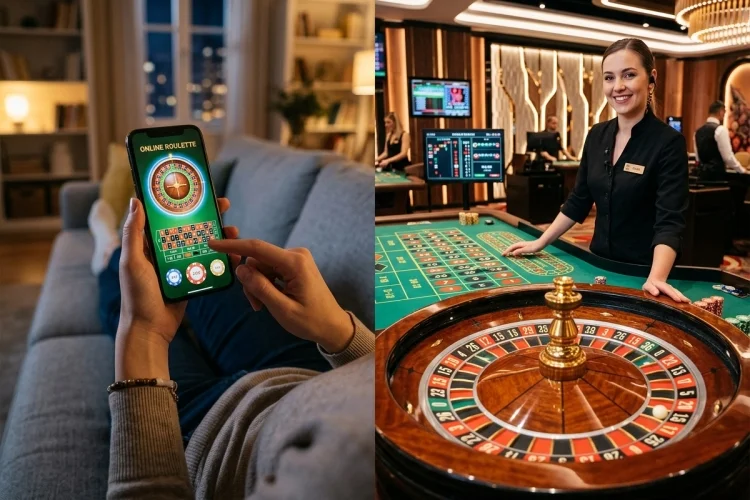
A digital roulette wheel can produce a result almost instantly. A live table takes a more theatrical route: the dealer accepts bets, spins a real wheel, launches the ball, and waits for gravity to finish the job.

Both are roulette, but they create noticeably different experiences. Comparing Online Roulette vs Live Roulette is therefore less about asking which one “wins” and more about understanding how each works.

Speed, internet requirements, interaction, betting pressure, table availability, and result generation can all differ even when the betting layout and payouts appear nearly identical.

Online Roulette Uses Software to Run the Entire Round

In regular digital roulette, software handles practically everything.

Your wagers are recorded electronically, an RNG generates the outcome, and an animated wheel displays the result.

The UK Gambling Commission’s remote-gambling guidance describes virtual-event systems as requesting random numbers, mapping them to game outcomes, and then instructing the player’s application to display both the result and settlement.

Evolution’s First Person range provides a practical example.

Its roulette game is entirely RNG-based even though the 3D presentation is designed to resemble an authentic roulette table.

This means there is no physical ball hidden somewhere off-screen. The software determines the result.

Live Roulette Builds the Digital Interface Around a Real Game

Live dealer roulette starts from the opposite direction.

The physical wheel comes first.

A dealer runs the table while cameras stream the action. Players use a digital interface to place bets remotely.

Evolution’s standard Live Roulette uses real wheels and live tables alongside betting tools, game statistics, chat, and multi-camera views.

Regulated live-dealer operations can also involve behind-the-scenes safeguards.

UK Gambling Commission standards require applicable live studios to use suitable equipment, trained croupiers, supervision, surveillance, access controls, and game logs.

So the smooth table you see on screen sits on top of a larger operational system.

The Difference in Pace Can Be Huge

If you dislike waiting, RNG roulette has an obvious practical advantage.

The game does not need to coordinate a shared live betting window.

Evolution’s First Person Roulette lets players operate at their own pace, including speeding up gameplay.

Live games follow the physical round.

The dealer needs time to take bets, spin the wheel, wait for the ball, verify the result, and prepare another game.

Some providers offer Speed Roulette or automated physical wheels to reduce waiting, but the experience still follows real-time table procedures.

This difference can have an overlooked financial effect.

More rounds per hour create more opportunities to wager. Faster does not mean better mathematical value; it simply means the bankroll can be exposed more frequantly.

Live Roulette Shows the Physical Result Process

One reason some players prefer live roulette is visual transparency.

You can watch the dealer spin the wheel and see the ball move until it lands.

Premium versions take this further. Evolution’s Immersive Roulette uses multiple camera angles, 200-frame-per-second HD footage, and slow-motion views of the ball reaching the winning pocket.

That can make the game feel more tangible.

But visual transparency should not be confused with mathematical superiority.

A properly regulated RNG game uses a different integrity system. UK standards require random results to meet randomness and unpredictability requirements, and gambling products can undergo independent testing.

The formats demonstrate fairness differently.

Live Roulette Adds Human Interaction

A major difference is the dealer.

RNG games do not need one.

Live games often allow players to watch a presenter, share rounds with other participants, and use chat features. Some tables also offer dealers speaking specific languages. Evolution’s portfolio includes numerous native-speaking tables alongside standard and VIP games.

This can make live roulette feel closer to visiting a real casino without leaving home.

On the other hand, not everyone wants that interaction.

A player who prefers a quiet, quick interface may find digital roulette more practical.

The “better” atmosphere is therefore mostly a matter of personal preference, not better odds.

Table Limits Can Feel Very Different

Live tables often come with specific minimum and maximum betting requirements.

One table might be intended for casual stakes, while another operates as a VIP table with considerably higher limits.

Evolution notes that its VIP roulette range includes higher betting limits, while its American Roulette format can have lower limits than some other variants.

Digital roulette usually has no physical seat or dealer capacity to consider.

That can allow software games to support a broad range of stakes without creating separate physical tables.

Still, limits depend on the game and casino operator.

Always check the minimum wager rather than assuming RNG automatically means cheap or live automatically means expensive.

Streaming Quality Matters Only for One Format

Live roulette is fundamentally a broadcast product.

The player needs to receive video in close coordination with the betting interface.

A poor network can lead to buffering, reduced resolution, or delays in the visual feed.

RNG roulette has far less video data to transmit because most graphics are generated directly on the player’s device or through the game client.

That makes digital roulette more practical on unstable connections.

Live games, meanwhile, are increasingly optimised for mobile use. Evolution says its supported live roulette tables are designed to work across desktop and mobile devices.

Still, a clean interface cannot completely compensate for a poor internet connection when live video is involved.

Hybrid Roulette Blurs the Difference

The distinction between online and live is becoming less clear.

Some games intentionally combine characteristics from both categories.

Evolution’s EZ Dealer Roulette, for example, uses prerecorded dealer video together with an RNG system. The winning number comes from the RNG rather than a physical wheel being spun live for that specific round.

That means a realistic dealer video does not automatically make a product genuinely live.

Automated roulette creates another variation.

A physical wheel may operate without a human dealer while the result is streamed online.

Players should therefore check the game description instead of deciding whether something is “live” purely from appearance.

Modern roulette now exists on a spectrum rather than in only two neat categories.

Payout Rules Matter More Than Production Style

Suppose an RNG game and a live game both use standard European single-zero rules and identical payouts.

The fact that one uses software and the other uses a physical wheel does not by itself create a different standard mathematical advantage.

Change one game to American double-zero roulette, however, and the mathematics change.

Evolution’s Live American Roulette includes 0 and 00, while its First Person American Roulette recreates the same double-zero format through RNG software.

This demonstrates the important point.

The number of zeros, payout schedule, and special rules are usually more relevant to theoretical return than whether the wheel is animated or physical.

Always compare rules before presentation.

Special Features Exist in Both Formats

Neither category is limited to plain roulette anymore.

RNG roulette can include multipliers, enhanced graphics, speed controls, and other modifiers.

Evolution’s First Person Lightning Roulette, for example, uses RNG gameplay with randomly generated multiplier numbers.

Live roulette has similar innovation.

Providers offer Lightning-style tables, immersive camera formats, speed games, double-ball products, and other variations.

The presence of a special feature can change payouts or volatility.

This means comparing “RNG versus live” is sometimes too broad.

Two live games can be more different from each other than a standard live table and a standard digital roulette game.

Interruptions Affect the Experience Differently

A connection interruption in RNG roulette can often happen between very short rounds.

Live roulette may already have a physical round underway when your connection fails.

Regulated operators need policies for interrupted gambling. UK standards require them to take reasonable steps to handle service interruptions fairly and explain how affected play will be treated.

This becomes especially relevent with live games because the dealer does not stop the table simply because one remote player’s internet drops.

Your wager may already have been accepted before the connection disappeared.

Read the operator’s interruption and settlement rules if this is a concern.

Which Format Fits Different Playing Styles?

Digital roulette suits players who value speed, privacy, flexible pacing, and lighter internet requirements.

Live roulette suits players who enjoy seeing a physical wheel, watching a dealer, sharing rounds, and getting something closer to a casino-floor presentation.

Neither description means one format is automatically smarter or more profitable.

Both remain casino games with payout structures that create a mathematical house advantage.

A more practical choice is to compare stakes, wheel type, rules, and pace against a fixed entertainment budget.

The presentation should come after those fundamentals.

Online Roulette vs Live Roulette is mainly a comparison between software-driven convenience and real-time casino presentation.

RNG roulette offers faster self-paced rounds, while live roulette adds physical wheels, dealers, streaming, and social interaction. Neither format automatically provides better odds.

Before choosing, compare the exact wheel, payouts, limits, connection requirements, and game speed, then select the format that matches how you prefer to play.

How Blackjack Payouts Work: 3:2, 6:5, Insurance, and Side Bets

How Blackjack Payouts Work: 3:2, 6:5, Insurance, and Side Bets

Two blackjack tables can look almost identical but have very different mathematics. One might pay 3:2 for a natural blackjack, another only 6:5, while a third includes side bets offering payouts of 25:1, 30:1, or even more.

That is why understanding How Blackjack Payouts Work requires more than knowing that a normal win pays even money. The payout table affects how much each result is worth, but probabilities matter just as much.

Learning to read those numbers can help you distinguish the main game from insurance and optional side wagers.

Start With “To One” Payout Language

Casino payout notation usually describes profit relative to the amount wagered.

A standard 1:1 payout means one unit of profit for every unit wagered.

If you bet $25 and win:

$25 stake + $25 profit = $50 total returned.

A 3:2 payout means $3 of profit for every $2 wagered. A $20 natural blackjack therefore produces $30 profit plus the original $20 stake.

This terminology matters because players sometimes confuse the stated payout with the total cash returned.

The original wager normally comes back separately when the bet wins.

Why 3:2 Is Better Than 6:5

The difference between 3:2 and 6:5 is one of the most important payout details on a blackjack table.

At 3:2, a $100 natural produces $150 profit.

At 6:5, the same winning hand earns only $120.

The $30 difference occurs every time a natural blackjack wins.

Wizard of Odds explains that a 3:2 natural pays 1.5 times the wager while 6:5 pays only 1.2 times. Its analysis shows that switching to 6:5 materially increases the house advantage when other rules remain unchanged.

The site’s broader rule-variation analysis also shows that blackjack payout rules have a significant effect on expected return.

This is why comparing table rules can matter more than choosing a visually nicer table.

An Ordinary 21 Is Not Always a Blackjack

A common beginner mistake is assuming every hand totaling 21 earns the blackjack premium.

It does not.

A natural blackjack specifically refers to an Ace plus a ten-value card as the original two-card hand.

If you begin with 7-5 and hit a 9, you reach 21, but the hand is normally just an ordinary winning 21 and pays 1:1.

The same issue appears after splitting.

Pagat notes that if split Aces receive a ten, or a split ten receives an Ace, the resulting two-card 21 normally does not qualify as blackjack.

Knowing this prevents a surprising payout when a hand visually looks like blackjack but is settled at even money.

How Even Money Relates to Insurance

When you hold blackjack and the dealer shows an Ace, some tables may offer even money.

Conceptually, this is closely related to taking insurance on your blackjack.

Insurance can typically be placed for up to half the original wager and pays 2:1 if the dealer’s hidden card completes blackjack.

Wizard of Odds explains that taking insurance while holding blackjack effectively converts the outcome into a guaranteed 1:1 profit in the standard setup: if the dealer also has blackjack, the main hand pushes while the insurance wins; if the dealer does not, the blackjack wins but the insurance stake is lost.

That sounds comfortable, but comfort and expected value are not the same thing.

Standard basic-strategy analysis generally treats insurance as an unfavourable wager without additional information about deck composition.

Large Side-Bet Payouts Can Be Misleading

Modern blackjack tables often display side bets with much larger payouts than the main game.

For example, 21+3 uses the player’s first two cards and dealer’s upcard to create poker-style combinations.

Depending on the paytable, straight flushes, three of a kind, straights, and flushes can receive premium payouts.

Wizard of Odds has analysed numerous 21+3 schedules. In one six-deck version, a 9:1 paytable produced a calculated 3.24% house edge. Another six-deck version with different payouts produced a much larger 13.39% house edge.

That is a powerful example of why headline prizes should not be evaluated by payout size alone.

Two bets with the same name can have very differnt mathematical values depending on the exact paytable.

Splitting Changes Your Total Exposure

Splitting does not create a bonus payout.

Instead, you place an additional wager equal to the first stake and play two hands. Each is then settled according to its own result.

Suppose you wager $25 and split.

You now have $50 total on the table.

If both hands win at 1:1, you earn $50 profit. If one wins and one loses, the two main results offset each other before considering any additional doubles or side wagers.

If you double one of those split hands, even more money becomes exposed.

This is why a $25 starting wager does not necessarily mean $25 is the maximum amount needed for the round.

A Push Is Not a Payout

A push can feel like a small win because no money is lost.

Mathematically, however, there is zero profit.

If both player and dealer have 18, the player’s original wager is normally returned. If both have natural blackjack under conventional rules, that also produces a push.

This distinction becomes important when reviewing gambling results.

Counting pushes as wins can make a session appear more successful than it actually was.

A practical record should distinguish between money won, money lost, and wagers simply returned.

Surrender Has Its Own Settlement Rule

Late surrender allows the player to give up certain hands after the dealer checks for blackjack.

Instead of risking the full wager, the player forfeits half and receives the other half back.

For example, surrendering a $40 wager normally means losing $20 and recovering $20.

This is technically not a winning payout.

It is a rule that reduces the loss in situations where surrender is strategically appropriate.

The availability of surrender can also affect the overall house edge, which is why it appears among the variables used in blackjack rule analysis.

Small Rule Changes Add Up

Players sometimes focus only on the payout for blackjack while ignoring everything else.

But overall expected return also depends on dealer soft-17 rules, number of decks, doubling permissions, resplitting, surrender, and how much is paid for a natural.

Wizard of Odds’ rule-variation data demonstrates that each condition can shift expected return by a measurable amount.

The UK’s Gambling Commission similarly describes blackjack as a banker game containing an inbuilt advantage for the house.

Payout tables are therefore only one part of the story.

A table advertising exciting side bets or a low minimum stake can still use rules that produce a less favourable mathematical structure.

Read the Table Before Placing the First Bet

Before joining a blackjack game, check at least the natural-blackjack payout.

Then look at whether the dealer hits or stands on soft 17, whether doubling after a split is allowed, whether surrender is offered, and which optional wagers appear.

If side bets interest you, read their payout table seperately.

Do not assume a 25:1 prize is attractive simply because the number is large. Probability determines how valuable that payout really is.

Also remember that basic strategy can reduce avoidable decision errors but does not remove the house advantage or guarantee a profit.

Blackjack outcomes can vary considerably over a short session.

Understanding How Blackjack Payouts Work means looking beyond the biggest number printed on the table. A 3:2 natural, 6:5 natural, insurance bet, side wager, split, or surrender all use different settlement rules.

Before playing, compare the complete paytable and table rules together. Knowing what each outcome pays makes it much easier to understand the real cost and value of every wager.

Behind the Scenes at a Live Casino Table: People, Tech, and Security

Behind the Scenes at a Live Casino Table: People, Tech, and Security

When a roulette dealer says, “No more bets,” it sounds like one simple moment in one simple game.

Behind that announcement, however, several systems may already be working at once: the video broadcast, betting interface, game records, surveillance cameras, table staff, and server infrastructure.

A closer look Behind the Scenes at a Live Casino Table shows how much coordination is needed to make physical casino equipment work online. The visible dealer is only one part of the operation.

Production teams, software systems, supervisors, and security controls quietly help keep each round moving from the studio floor to thousands of screens.

Live Tables Are Part Casino and Part TV Studio

A live casino studio borrows ideas from two very different industries.

From traditional casinos, it takes physical tables, cards, roulette wheels, dealers, and established game procedures.

From television production, it takes cameras, professional lighting, microphones, sets, directors, and broadcast infrastructure.

Evolution describes purpose-built live studios as environments where professional hosts and advanced streaming technology deliver casino tables and game shows across different markets and devices.

Playtech also describes its live casino network as purpose-built studio space using advanced audio-visual technology and trained presenters.

That hybrid structure explains why a professional live table looks so different from someone simply streaming a physical casino through a webcam.

A Dealer Has a Strict Operational Routine

Live dealers may appear relaxed, but a round usually follows a defined process.

A baccarat dealer must handle cards consistently. Blackjack dealers have to manage actions in the correct order. Roulette dealers need to control the betting window, spin procedure, result announcement, and preparation for the next round.

In jurisdictions governed by UK Gambling Commission technical standards, croupiers are expected to be trained and to follow documented procedures and game rules. Refresher training should also be recorded.

Dealers are also presenting to a camera rather than people sitting directly in front of them.

That changes body language.

They need to address remote players, communicate clearly, and maintain the right pace even when thousands of people may be watching from different locations.

It is a surprisingly specialised job.

There May Be Far More Cameras Than You Think

The camera pointed directly at the dealer is only the beginning.

Evolution says the industry evolved from basic webcam broadcasts into multi-camera HD productions with better sound and more carefully designed environments.

Pragmatic Play says its live casino solution uses multiple 4K-quality cameras.

A production may need one angle for the dealer, another for the physical table, and close-ups for cards or a roulette wheel.

Game-show formats can become even more elaborate.

Evolution’s Crazy Time production, for example, combines multi-camera live action with digital technologies including augmented reality and RNG-driven elements.

The result is closer to broadcast entertainment than traditional CCTV footage.

Lighting Is More Technical Than It Looks

Good lighting should almost disappear from the player’s attention.

Cards need to remain readable. Dealer faces should look natural. Reflective equipment cannot create distracting glare, and virtual backgrounds may need perfectly consistent colour.

Evolution has described the technical challenges involved in adapting chroma-key production to smaller live casino spaces. Its teams had to manage shadows and uneven colour so virtual elements could work reliably around the presenter.

This is another reason studios are purpose-built.

A normal room may look perfectly bright to the human eye but perform badly on professional cameras.

The studio needs lighting that works continuously while maintaining consistent image quality across long operating hours.

Player Bets Exist in a Separate Digital Layer

The physical table does not directly know that you tapped $5 on red.

Your bet exists within the casino’s digital platform.

The interface tracks the wager, betting period, balance, table limits, and eventual settlement while the dealer continues the physical game.

Those systems must remain aligned.

If betting is officially closed at the physical table, the online interface cannot continue accepting late wagers. Likewise, the correct result must be attached to the correct betting round.

This creates a constant relationship between physical timing and digital records.

UK Gambling Commission standards require gambling systems under their scope to process and settle wagers in accordance with published game and betting rules.

The flashy betting interface is therefore doing much more than displaying virtual chips.

Physical Results Have to Be Tracked Accurately

When the dealer reveals cards or the roulette ball stops, the outcome has to enter the digital system.

How that happens can vary by game and studio.

Some live casino systems have used tools such as barcoded cards and other forms of table technology to help connect physical actions with the online platform.

Evolution identifies barcoded cards as one of the technical developments introduced as its live casino environments became more advanced.

The important objective is accurate game tracking.

Once the result is captured, software can determine which accepted wagers qualify under the published rules.

The result also becomes part of game history and operational records.

This is one of the least visible but most importent steps in the entire round.

Surveillance and Broadcast Cameras Have Different Jobs

The attractive close-up of a roulette wheel is designed for the player.

Surveillance has a different purpose.

UK live dealer standards require enough video surveillance to record dealer activity and confirm whether procedures and rules were followed. Supervisory staff should also oversee dealer activities and integrity.

That means a studio may contain cameras whose footage players never see.

Security coverage may focus on tables, dealers, equipment, or restricted areas rather than creating cinematic images.

The standards also call for appropriate access controls around secure areas and gambling equipment.

Behind the glamorous studio backdrop is therefore a more practical security environment.

Game Logs Create a Digital Paper Trail

A physical casino can rely heavily on surveillance and table procedures.

An online live casino also generates electronic information.

UK technical guidance says live dealer operations should maintain game logs, with game events collated into statistics that can be analysed for trends involving games, staff, or gaming locations.

This creates an operational record beyond the public video stream.

Logs can help investigate unusual situations, monitor performance, and support auditing.

Imagine a dispute about what occurred several rounds earlier. The operator does not necessarily have to depend on someone’s memory of the table.

The combination of surveillance, transaction records, and game logs can provide a much more detailed picture of the event.

Low Latency Matters Because Betting Is Time Sensitive

A live movie broadcast can tolerate a small delay without changing the story.

Live gambling is different because betting windows and decisions are time-sensitive.

Video must be captured, encoded, distributed, and rendered while digital betting information stays in sync.

Evolution says latency, video synchronization, and sound became increasingly important as live casino systems developed.

Playtech similarly highlights investment in streaming technology and high system availability as part of its live casino platform.

The player’s device and internet connection add another variable.

Someone on a weak connection may see the same table slightly later than another player even though the physical round occurred at exactly the same moment.

Dedicated Tables Can Be Built for One Casino Brand

Not every studio table is visually generic.

Providers can build dedicated areas for specific operators, complete with customised décor, dealers, and table presentation.

Evolution’s earlier PokerStars dedicated environment in Riga, for example, included nine branded live tables with dedicated dealers and a multi-camera studio setup.

This model lets an online casino present what appears to be its own live gaming room even though the production infrastructure belongs to a specialist supplier.

Modern studios may also localise tables by language or market.

That explains why two casinos using the same underlying live provider can still look noticeably different on screen.

The production can be customised without rebuilding the basic technology from scratch.

Technical Problems Need Predefined Procedures

Live casino systems cannot assume that every connection remains perfect.

Network interruptions, software errors, and hardware failures are possible.

UK standards state that gambling systems should have fair procedures for interrupted play. Depending on the situation, systems may need to preserve information, restore an event to its previous state, or void a wager and return the stake.

For multi-stage games, retained information can include cards already dealt and bets placed.

This demonstrates why back-end records matter.

A disconected player may only see that the stream stopped. Behind the scenes, the platform still needs enough information to determine what happened and how the affected round should be handled.

The Dealer Is Only the Visible Tip of the Operation

A live table can involve far more people than appear on screen.

Dealers run the visible game, supervisors oversee operations, production teams maintain cameras and presentation, and technical staff keep streaming and software infrastructure functioning.

Security and compliance teams can also play a role.

Playtech says significant investment in technology, product development, and game-presenter training supports its global live casino operation.

Evolution’s description of its development tells a similar story: as its studios expanded, quality increasingly depended on systems, standards, training, and specialist teams rather than a simple camera-and-table setup.

That is why a professional live table can feel effortless even though the production behind it is anything but simple.

A look Behind the Scenes at a Live Casino Table reveals a mix of casino procedure, television production, software engineering, security, and operational control.

The dealer may be the face of the game, but cameras, supervisors, game tracking, logs, and streaming systems keep each round connected. Before your next live game, notice how much technology quietly works around the physical table.

Fixed Paylines vs Adjustable Paylines: Which Slot System Does What?

Fixed Paylines vs Adjustable Paylines: Which Slot System Does What?

The number of paylines printed on a slot game can look like a simple technical detail, but it can tell you quite a lot about how wins and wagers are structured.

What matters even more is whether those lines are permanently active or can be switched on and off.

The debate around Fixed Paylines vs Adjustable Paylines is really about two different approaches to slot design. One keeps every available winning pattern active on every spin.

The other gives the player some control over line coverage and often the overall stake. Neither system predicts results, but they create noticeably different gameplay experiences.

Why Paylines Exist in the First Place

Paylines tell a slot which symbol positions should be evaluated together for a potential win.

On an old three-reel machine, there might be only one horizontal line through the middle.

Modern video slots can have five, ten, twenty, fifty, or many more patterns. These lines can travel horizontally, diagonally, or through zigzag formations.

Evolution defines paylines as winning arrangements of symbols across reels and notes that they can take several geometric forms.

The number of lines is therefore not the number of rows visible on screen.

A standard five-reel, three-row slot can still contain dozens of different winning paths through the same 15 symbol positions.

Fixed Paylines Keep Full Line Coverage Active

A fixed-payline game activates every line automatically.

If the game has 25 lines, every one of those 25 lines participates in every spin.

You cannot normally switch individual lines off simply to reduce the wager.

The practical benefit is simplicity.

There is no need to wonder whether a symbol combination landed on an inactive line. If it matches one of the game’s valid paylines and satisfies the paytable requirements, the game evaluates it.

Many modern games simplify things even further by allowing players to choose a total stake rather than manually calculating coins per line.

This makes the betting interface cleaner, especially on mobile screens.

Adjustable Paylines Give More Betting Control

Selectable lines work differently.

PokerStars explains that while some slots have fixed paylines, other titles let players choose how many paylines are active.

Imagine a 20-line game that allows you to activate between one and twenty lines.

You might decide to play five lines at $0.10 per line for a total stake of $0.50.

Activating all twenty at the same $0.10 line stake would cost $2 per spin.

That gives the player more control over the wager structure.

However, it also introduces another decision: how much of the reel grid should actually be covered?

The ability to lower line count should not be confused with changing the underlying randomness of the reels.

More Active Lines Means More Coverage

The most obvious difference appears after the reels stop.

Suppose a matching combination lands on line 12.

If you activated all twenty lines, it can be evaluated as a potential winning combination. If you activated only lines one through ten, line 12 is outside your active coverage.

This is why fewer paylines can produce situations where matching symbols appear but no line prize is awarded.

PokerStars’ slot rules state that the aim is to match symbols along active paylines and that individual game paytables define the required combinations.

More active lines therefore provide greater line coverage.

But they may also increase the total amount wagered.

Coverage and cost need to be considered together.

How Paylines Affect Hit Frequency

Hit frequency generally refers to how often a game produces some form of winning result.

In a selectable-line game, activating more lines gives the slot more active routes on which line combinations can qualify.

That can make winning events appear more frequent compared with playing only a small part of the available line set, all else being equal.

But this does not mean you have discovered an advantage.

If the total wager rises when more lines are activated, you are paying for that additional coverage.

A $0.20 return on a $1 spin is technically a winning event on the reels, but financially the spin still resulted in a net loss of $0.80.

This difference between a line win and an actual profit on the spin is extreemly important when judging how “often” a slot seems to pay.

Payline Count Does Not Tell You RTP

A slot with 50 paylines is not automatically better than one with ten.

Likewise, a fixed-line game is not automatically more generous than an adjustable-line game.

Return to Player depends on the complete mathematical model.

The UK Gambling Commission explains that RTP represents a theoretical percentage measured over a large number of games, not a prediction of what one person will receive from a short session.

Symbol probabilities, paytable values, wilds, scatters, free spins, jackpots, and other features all contribute to a game’s mathematics.

The visible line count is only one piece of that system.

When RTP is provided, read the official game information rather than estimating it from the number of active paylines.

Payline Structure and Volatility Are Different Concepts

Another common mistake is assuming that more paylines automatically mean lower volatility.

Volatility describes the pattern in which potential payouts are distributed. A game can have dozens of active lines and still be designed around relatively infrequent large payouts.

Another game may have fewer paylines but produce modest awards more regularly.

Payline configuration influences how combinations are evaluated, while volatility relates to the broader payout distribution.

The two may interact within a game’s mathematical model, but one cannot be reliably determined from the other.

This is another reason why comparing games by line count alone gives an incomplete picture.

Bonus Symbols May Follow Different Rules

Not every important symbol needs to land on a traditional payline.

Scatter symbols often use different rules.

PokerStars explains that scatter symbols can trigger payouts or features when they appear across the reels, although the exact requirements depend on the individual game.

Some games may also tie bonus features to active paylines.

For example, the published rules for Tiki Island state that some bonus symbols must appear on active paylines to trigger particular features.

Its rules also specify that between one and twenty paylines can be played and that total bet is calculated from paylines multiplied by coin size.

This demonstrates why generic assumptions can cause problems.

Always check whether special features depend on line selection before reducing the number of active lines.

Modern Slots Are Moving Beyond Traditional Lines

Paylines are no longer the only way to calculate slot wins.

Ways-to-win systems, Megaways, cluster pays, and scatter-pay mechanics have become common alternatives.

PokerStars notes that paylines have evolved significantly from the original single horizontal winning line, while modern designs can use many different payout arrangements.

Megaways takes this further by changing the number of symbols visible on the reels and therefore changing the number of possible winning ways between spins. Evolution notes that many Megaways titles can offer up to 117,649 ways to win.

These “ways” are not simply adjustable paylines under another name.

They use a diffrent method for determining qualifying combinations.

Which Details Matter More Than the Line Count?

The headline payline number is only a starting point.

Before playing, check the total cost per spin, minimum and maximum stake, paytable, RTP, wild rules, scatter conditions, bonus triggers, and any available volatility information.

For adjustable games, confirm how changing the number of active lines alters the total wager.

Also check whether certain features require maximum lines or specific betting conditions.

A slot with fewer lines may cost more per spin than another game with many fixed paylines.

The actual wager is more important to bankroll management than the number printed beside the word “lines.”

That is a simple but very usefull distinction.

Fixed or Adjustable Does Not Predict the Next Spin

Neither payline structure gives information about what the next random outcome will be.

Changing from ten lines to twenty does not mean the reels are suddenly “due” to create a winning symbol pattern. Similarly, reducing the number of active lines does not make the unused lines more likely to hit.

Random game outcomes should not be interpreted using previous wins and losses as a prediction system.

The UK Gambling Commission notes that for random gaming machines, the chance of winning the current game is not affected by whether previous games were wins or losses.

Payline selection changes coverage and potentially stake size, not what past results mean.

The key difference in Fixed Paylines vs Adjustable Paylines is straightforward: fixed games keep every line active, while adjustable games let you control line coverage.

That choice can influence total stake and how many patterns qualify for wins, but it does not remove the game’s mathematical edge. Check the paytable and total wager carefully before choosing how many lines to activate.

Beginner’s Guide to Online Casinos: Play With Better Understanding

Beginner’s Guide to Online Casinos: Play With Better Understanding

Your first visit to an online casino can feel more like opening a giant entertainment app than entering a traditional gambling venue. Slots, live tables, jackpots, bonuses, and colourful promotions are often available from the same screen.

But beginners benefit from understanding what is happening behind those buttons.

This Beginner’s Guide to Online Casinos explains the practical side of choosing games, interpreting casino mathematics, managing money, understanding promotions, and recognising basic player protections.

The more you understand before depositing, the easier it becomes to separate useful information from marketing.

Start by Understanding the House Edge

Casino games involve a mathematical advantage for the operator, commonly called the house edge.

The exact percentage depends on the game, rules, bets available, and sometimes player decisions. It represents a long-run mathematical concept rather than a prediction about what will happen in one session.

Imagine a game where the casino has a theoretical advantage of 2%. That does not mean you automatically lose exactly $2 every time you wager $100.

Individual sessions can move in either direction because outcomes vary.

Understanding the house edge helps beginners recognise an important point: casino games should not be treated as predictable investments.

Random Does Not Mean Results Must Balance Quickly

One of the biggest beginner misunderstandings involves randomness.

If a roulette wheel produces several red results, black does not become automatically “due.” Likewise, losing several slot spins does not mean a large prize must arrive soon.

On random gaming machines, the UK Gambling Commission notes that the chance of achieving a win in the current game is not affected by previous wins or losses.

This is important because people naturally look for patterns.

A sequence that looks unusual can still occur randomly. Previous outcomes may be visually interesting, but they do not necessarily provide information about the next independent result.

Avoid building a betting decision around the idea that the game must compensate for earlier outcomes.

Choose Games by Rules, Not Graphics

Great graphics do not tell you whether a game suits your budget or preferences.

Two slots with similar themes can have different RTP percentages, volatility levels, maximum payouts, paylines, and bonus structures. Likewise, different blackjack tables may use different rules.

Before betting, open the information panel.

Check the paytable, minimum wager, maximum wager, bonus rules, and any available RTP information.

For beginners, lower betting limits can make bankroll management easier because the same budget can cover more individual rounds.

Do not assume a complicated game is automatically better. Simple rules are often easier to understand and track.

RTP and Volatility Explain Different Things

RTP and volatility are frequently discussed together, but they are not identical.

Return to Player describes a theoretical long-term return. The UK Gambling Commission explains that the percentage is achieved over a significant number of plays, not every time the game is played.

Volatility generally describes how unevenly those potential payouts may be distributed.

A lower-volatility game may tend to produce smaller prizes more regularly, while a higher-volatility design may concentrate more of its theoretical return in less frequent larger payouts.

Neither structure guarantees a better individual result.

When reading game information, consider both concepts rather than choosing based only on the highest displayed RTP percentage.

Casino Licensing Deserves More Attention Than Reviews

Online reviews can be helpful, but regulatory information is more important.

A legitimate licence identifies the company responsible for operating the casino and the regulatory framework applying to it.

In Great Britain, operators must provide their licensed status when customers open accounts, and consumers can verify companies using the Gambling Commission’s public register.

MGA-regulated operators must also provide information such as licensee details, responsible gaming resources, and links to gambling support organisations.

A website claiming to be “trusted” means very little by itself.

Verify important information independently whenever possible instead of relying entirely on marketing claims or review scores.

Treat Welcome Bonuses as Conditional Offers

A huge deposit bonus can make one casino appear more attractive than another.

However, the size of a bonus is only one part of the deal.

Promotions may contain wagering requirements, time limits, restricted games, maximum qualifying bets, or other rules. UK regulatory guidance says restrictions on playing with bonus funds should be made clear to consumers.

For a simple example, imagine receiving $100 in bonus funds with a 10x wagering requirement applied to that bonus.

That would represent $1,000 in qualifying wagers before the wagering condition is completed.

The calculation becomes more complicated if certain games contribute only partly or not at all.

Read bonus conditions before opting in. A smaller, simpler offer may sometimes be easier to understand than a larger promotion loaded with requirments.

Learn the Payment Process Before Depositing

The deposit button is normally easy to find. Withdrawal information can require more reading.

Check which currencies and payment methods the platform supports. Look at minimum transactions, potential fees, withdrawal limits, and verification requirements.

You should also learn whether withdrawals can be returned through the same payment channel used for deposits.

Identity checks are normal in many regulated markets. For instance, the UK Gambling Commission states that its licensed online businesses must verify a customer’s age and identity before gambling.

Depending on circumstances, identification documents or proof of address may be needed.

Use your own payment details and accurate account information. Mismatched details may cause unneccessary complications during verification.

Create a Session Plan Instead of Chasing Results

A beginner may start with a clear $30 budget and then decide to add another $30 after losing.

The second deposit can feel reasonable because the goal changes from entertainment to “getting the first $30 back.”

That is how chasing losses begins.

The Malta Gaming Authority states that players should not be encouraged to chase losses or spend more than they can afford, and its player-protection framework requires licensed operators to provide safer gambling tools.

GamCare also advises setting money and time limits and sticking to them when gambling.

Decide your maximum spending and session length beforehand.

Once either limit is reached, ending the session is much simpler than creating another rule while emotional.

Use Responsible Gambling Tools Before You Need Them

Deposit limits and time controls are sometimes misunderstood as features only for people already experiencing gambling problems.

They can also work as ordinary budgeting tools.

A deposit limit can prevent spontaneous spending beyond a planned entertainment budget. Time limits or reminders can stop a short session from quietly becoming several hours.

Self-exclusion provides a stronger restriction for people who need to stop gambling for a defined period or longer.

Player-protection frameworks such as the MGA’s require responsible gaming information and tools to be made available to customers.

Setting boundaries early is generally easier than trying to rebuild them after gambling habits become difficult to control.

Keep Records of Deposits and Withdrawals

Memory is not always a reliable way to measure gambling results.

A big win is memorable. Ten small deposits spread across a month can be surprisingly easy to forget.

Review your transaction history periodically and compare total deposits with total withdrawals.

For example, withdrawing $300 sounds positive until you realise that $450 was deposited during the same period.

Looking at actual records provides a clearer picture than focusing on individual wins.

It can also reveal changes in spending frequncy before those changes become significant.

Treat casino expenditure the same way you would track any other entertainment expense.

Know When Entertainment Has Changed

Gambling should remain optional entertainment.

Warning signs can include spending money intended for necessities, increasing wagers to recover losses, hiding gambling activity, borrowing money, or repeatedly playing longer than intended.

GamCare lists borrowing money, unexplained debts, secrecy, and behavioural changes among signs associated with harmful gambling.

If gambling starts affecting finances, relationships, work, or wellbeing, continuing to search for a better strategy is not the right response.

Use available limits, take a break, self-exclude where appropriate, and seek qualified support if needed.

Knowing when to stop is more important than knowing another betting system.

This Beginner’s Guide to Online Casinos comes down to a few fundamentals: understand the mathematics, verify regulation, read game and bonus rules, learn the payment process, and control your budget.

Casino games involve uncertainty and a house advantage, so approach them as entertainment rather than income. Before playing, review the rules and set your financial and time limits first.